
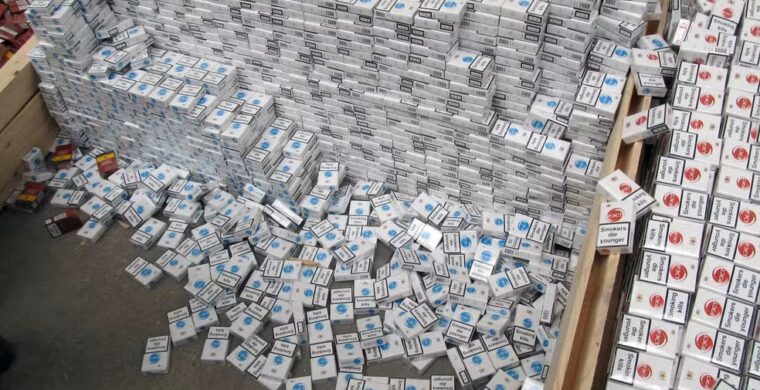

Small-scale smuggling where an individual purchases cigarettes in one country, where the taxes are low, and sells them in another country where taxes are higher. Tobacco products are produced for export by a legitimate manufacturer but are smuggled to a different country en route without paying any tax.
11.6% of the global cigarette market is illicit. At least US$40.5 billion in current tax revenues is lost each year by governments to illicit trade. The burden of illicit cigarette trade falls mainly on low income and middle income countries.
The revenue ranking in the ‘Cigarettes’ segment of the tobacco products market is lead by China with 278.7 billion U.S. dollars, while the United States is following with 82.7 billion U.S. dollars.
The black market in cigarettes and other tobacco products is increasingly dominated by organised crime.
The global tobacco market size was estimated at USD 886.09 billion in 2023 and is expected to grow at a compound annual growth rate (CAGR) of 2.5% from 2024 to 2030 due to the rising tobacco consumption in the developing regions of Asia and Africa.
Japan was the leading cigarette importing country worldwide in 2022. The nation imported around 1.6 billion U.S. dollars worth of cigarettes in that year.
On the other hand, tobacco manufacturers and wholesalers gain from smuggling in several ways: they make their profit when the product is first sold; smuggling creates a supply of cheap cigarettes and lowers average prices, boosting demand; and smuggling enables tobacco company lobbyists to press for lower rates of…
Global illicit trade in tobacco is a growing problem, but it’s considered low-risk, high-reward. Incentives matter. Billions of dollars are made each year through smuggling. To make matters worse, smuggling operations involve corruption, money laundering, and terrorism.
Illegal Market in Brazil
The illegal market in Brazil moves billions of reais every year, directly impacting the formal economy, tax collection, and public safety. One of the most affected products is cigarettes, with the illegal trade accounting for around 40% of total consumption in the country. Most of these products are smuggled into Brazil, mainly from Paraguay, and sold at much lower prices due to tax evasion.
This illegal trade finances criminal organizations, weakens national industry, and poses health risks to the population, as these products do not comply with health regulations.
How do you combat illicit trade?
- Understand the scope of the problem. …
- Enable consumer awareness and education. …
- Call for tough penalties and strong enforcement. …
- Seize and destroy. …
- Enhance supply chain controls. …
- Foster public-private partnerships.
Robinson Araujo – jun 2025

One Comment
Celso Corrêa
Parabéns Robinson, ótimo texto e ótima reflexão. 👏🏻👏🏻👏🏻